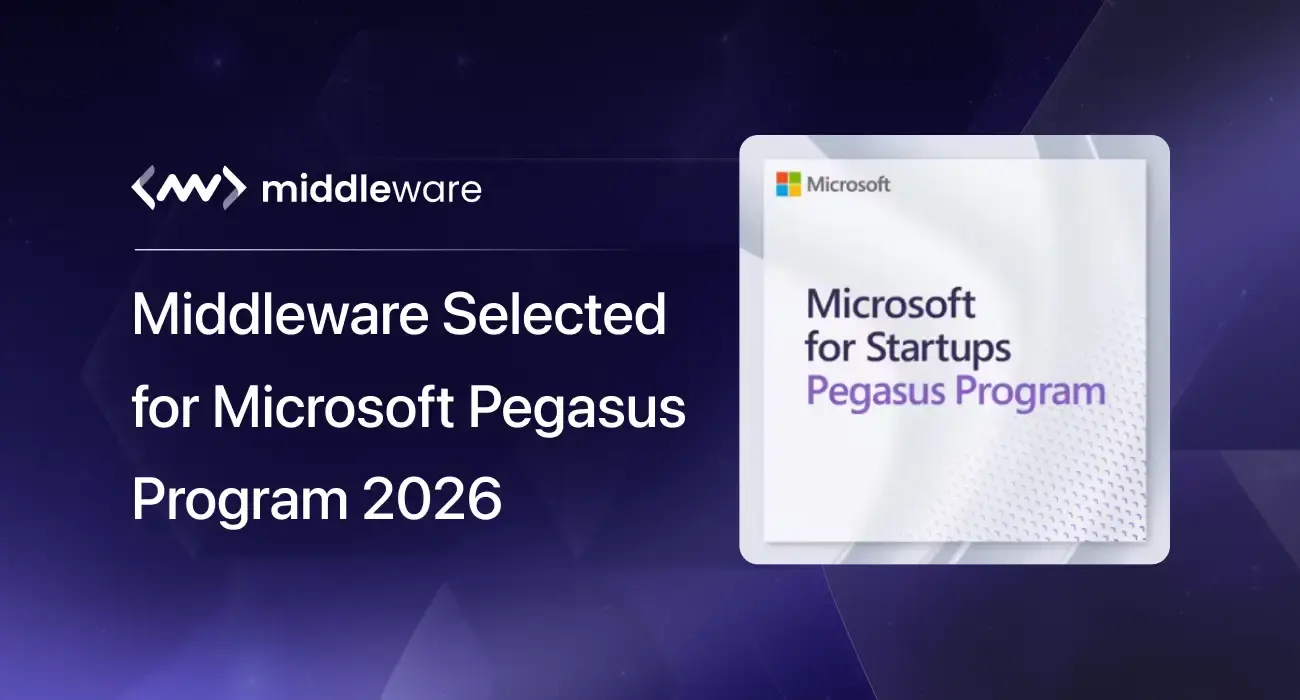
Today marks a defining moment in Middleware’s journey. We’ve been selected for the invite-only Microsoft for Startups Pegasus Program 2026 and are now live on the Microsoft Azure Marketplace. This is more than an accelerator entry; it signals enterprise alignment, technical maturity, and the start of a deep collaboration with Microsoft’s global ecosystem.
Why We Built Middleware
When we started building Middleware, the goal wasn’t to create another monitoring tool. I spent years watching engineering teams struggle with a fundamental operational flaw: data fragmentation. In most organizations, the problem isn’t a lack of data; it’s an overwhelming surplus of disconnected signals.
Historically, observability was a patchwork of specialized tools. Infrastructure metrics lived in one platform, logs were siloed in another, and traces were buried in a third. Real-user data was almost always disconnected from the backend telemetry that explained it.
The ‘Swivel-Chair’ Problem
During production incidents, when every second counts, engineers often switch among five dashboards and manually piece together a timeline as systems continue to fail.
In modern distributed systems, failures cascade quickly. A latency spike in your frontend might be caused by a database query bottleneck, Kubernetes resource starvation, or an upstream service dependency. Failures rarely stay isolated.
“We built Middleware around a simple idea: observability should reduce complexity, not multiply it. Instead of stitching together separate monitoring products, we designed a unified platform where logs, metrics, traces, infrastructure signals, database insights, and user sessions work together by default. “
Laduram Vishnoi, CEO & Founder, Middleware
What the Pegasus Program Represents
The Microsoft Pegasus Program is a highly selective, invite-only initiative for high-growth B2B technology companies that have demonstrated strong product-market fit and are actively serving large enterprise customers, not startups, in the ideation phase.
Companies selected move beyond the role of a standard vendor. We now have direct collaboration with Microsoft’s cloud and engineering teams, deeper access to Azure architects to optimize for heavy workloads, and expanded go-to-market reach within Microsoft’s global ecosystem.
For our customers, this means faster innovation cycles and an observability layer that stays ahead of the infrastructure it monitors.
Now Available on the Azure Marketplace
Enterprise software adoption is often slowed not by the technology itself, but by procurement. Our listing on the Azure Marketplace gives organizations running on Azure a streamlined path to discover, evaluate, and deploy Middleware within their existing ecosystem.
Simplifying the “Business” of Observability
Procurement is traditionally one of the longest stages in software adoption. Our availability on the Marketplace simplifies this significantly:
- MACC Eligibility: Purchases made through the marketplace count toward Microsoft Azure Consumption Commitments (MACC). This allows organizations to leverage their existing Azure budgets rather than fighting for new, separate line items.
- Unified Billing: Middleware is included as a line item on your existing Microsoft invoice, eliminating the need for complex new vendor onboarding.
- Operational Speed: Engineering teams gain faster access to unified observability, while finance and procurement teams benefit from commercial alignment.
OpsAI: Beyond the Alert
Most monitoring platforms are reactive; they detect an anomaly, fire an alert, and wait for a human to respond. In 2026, the volume of data in a modern environment makes that approach unsustainable. This is where OpsAI comes in.
“OpsAI doesn’t just notify you that something is wrong; it tells you why and how to fix it.”
OpsAI autonomously correlates signals across logs, metrics, traces, Kubernetes events, and real user sessions. It performs a full root cause analysis in under 2 minutes and resolves approximately 70% of common infrastructure and Kubernetes issues without human intervention.
Instead of overwhelming a DevOps team with thousands of raw alerts, OpsAI compresses that noise into a small set of actionable insights. As a result, teams can focus on resolving issues faster. Once a fix is identified, OpsAI can generate a pull request directly in your Git repository or Kubernetes environment for engineer approval.
Openwit: Built for Petabyte-Scale
Observability data grows exponentially. Telemetry from AI systems, containerized workloads, and high-cardinality metrics can quickly become a cost and performance bottleneck. To support enterprise-scale workloads, we built Openwit. This custom storage and query engine is written in Rust for memory safety and fast queries.
Even under massive load, query results are near-instant. High-density storage keeps costs predictable. By owning the engine, we ensure the platform never becomes a bottleneck during an incident.
Enterprise-Grade Security and Compliance
Middleware is SOC 2 Type II certified, EU GDPR compliant, VAPT certified, and HIPAA compliant. Trust is the foundation of any enterprise deployment, and we’ve invested heavily in meeting the most rigorous global standards.
A Pricing Model That Scales With You
We’ve moved away from restrictive per-seat or per-host licensing. Middleware uses a flat data-ingestion pricing model with unlimited users and hosts. Every engineer can access the data they need without worrying about incremental costs.
Looking Forward
Joining the Pegasus Program is not a finish line, it’s an inflection point. As distributed systems grow more complex and AI-driven workloads introduce new operational variables, the need for intelligent, autonomous observability has never been more urgent.
Middleware’s focus remains clear: unify observability systems, automate incident resolution, reduce costs, and deliver clarity amid complexity. Collaborating more deeply with Microsoft and expanding within the Azure ecosystem lets us advance that vision faster and at greater scale.
The journey into the future of observability is just beginning, and we’re excited to have you with us.